




VAT Return Filing in UAE:
Value Added Tax, called VAT, is implemented in UAE from Jan 1st, 2018. In the first phase Vat in implemented in UAE and KSA; however, the other GCC countries will implement Vat in 2019 as per reports as of today. Bahrain already approved the Vat law while Oman is expected to implement Vat in Sep 2019. The crux of Vat in UAE or in any country is to submit Vat report to relevant authorities, the documents are called Vat Return while the process is called Vat Return Submission, in UAE relevant authority, is called Federal Tax Authority (FTA). In this article, we will discuss how to file the Vat Return or UAE Return Filing with FTA.
Where to Submit:
Under UAE VAT, the businesses are divided into various categories depending upon their size. Hence the first return filing was in Feb followed by March, April till June 2018. The first VAT return was due on 28th Feb 2018 for companies that are required to submit a monthly VAT return. The businesses are required to file the VAT Return online using the Federal Tax Authority (FTA) portal. The FTA Portal is designed to accept the returns only through online mode until further information. This implies that the taxpayer is required to manually provide the values of Sales, Purchase, Output VAT, and Input VAT, etc. in the appropriate boxes of the VAT return form available in the FTA portal.
Vat Return Form:
The VAT Return is required to submit using a form, called ‘VAT 201’ available on the FTA portal. The Form VAT 201 is broadly categorized into seven sections as mentioned below:
1. Taxable Person Details
2. VAT Return Period
3. The VAT on sales and all other outputs
4. The VAT on expenses and all other inputs
5. Net VAT Due
6. Additional reporting requirements
7. Declaration and Authorized Signatory
There is another form called Vat Voluntary Disclosure Form 211 to be filled under certain circumstances, explain later in this article. Each of these sections contains various boxes in which the taxpayer needs to furnish the details in order to complete the VAT Tax return filing. Each of the above sections and the details required to be furnished in relevant boxes of VAT Return Form 201 are discussed below.
To access the VAT Return Form 201, the taxpayers should log in to the FTA e-Services portal using their registered username and password. Form Navigation menu, select the ‘VAT’->VAT 201- VAT Return->click on ‘VAT 201-New VAT Return’ to initiate the VAT return filing process.
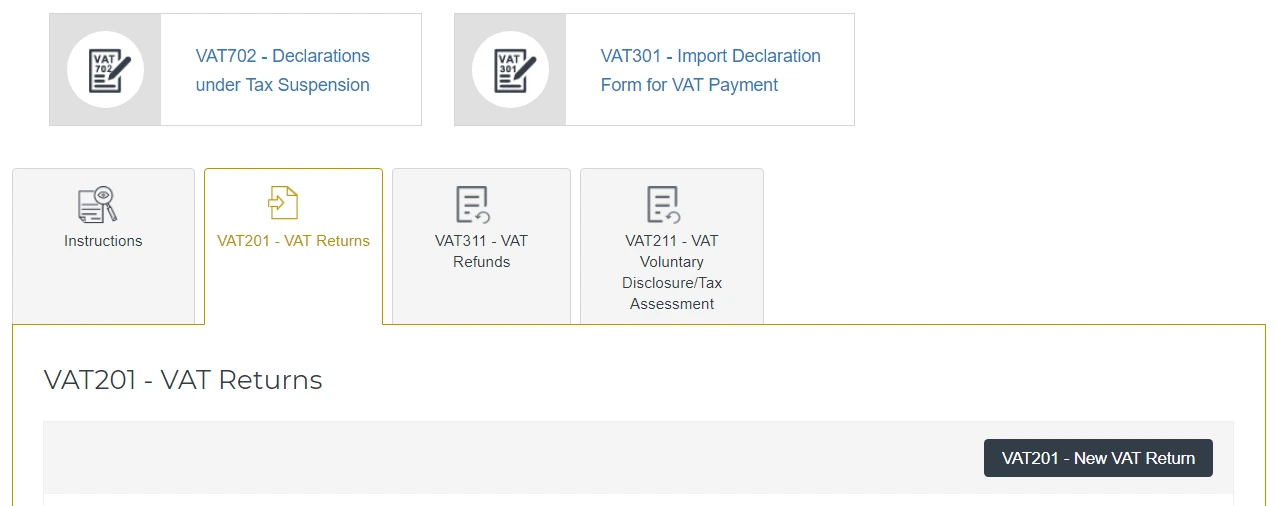
On clicking ‘VAT 201- New VAT Return’ as shown in the above image, various sections of the VAT return form will open. Let us explain the process step by step to filing the VAT Tax return.
1. Taxable Person Details
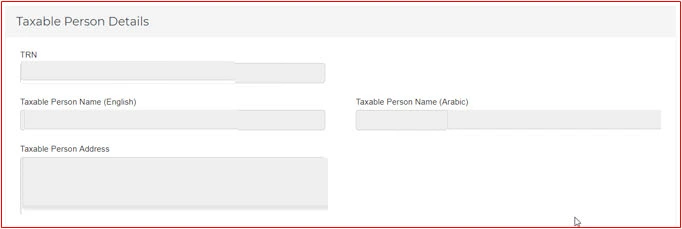
In the above section, details such as the “TRN” or “Tax Registration Number” of the taxpayer, as well as their name and address, will be automatically populated. If a tax agent is submitting the VAT return on behalf of a taxpayer, the details of TAAN (Tax Agent Approval Number) and the associated TAN (Tax Agency Number) along with the Tax Agent and the Tax Agency name is populated at the top of the VAT Return automatically.
2. VAT Return Period
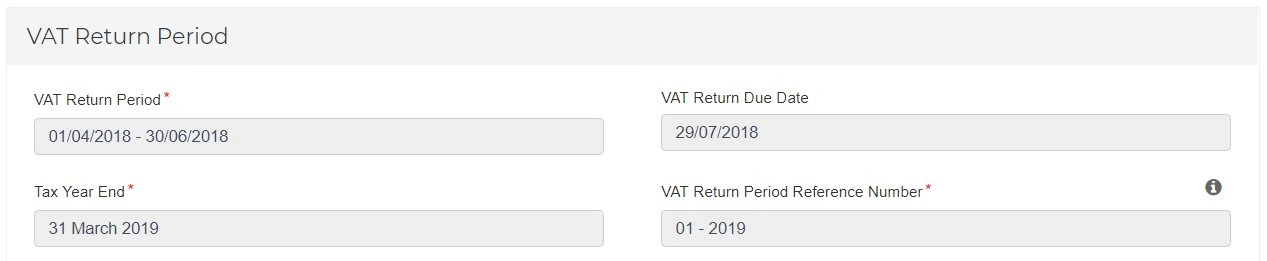
The details in the above section such as the VAT return period for which you are currently filing a return, the Tax Year-end, VAT return period reference number and VAT return due date will be auto-populated. The tax year-end is important for businesses that are not able to recover all of their input VAT and need to perform an input tax apportionment annual adjustment. Such adjustment is allowed only in the first return following the tax year-end. VAT return period reference number indicates the VAT return period which you will be completed within that tax year. If the VAT return period reference is 1, those businesses should include their input tax apportionment annual adjustment in that VAT return. Businesses need not worry now, because this is applicable after 1st year of VAT return i.e. from 1st January 2019 onwards.
3. The VAT on sales and all other outputs
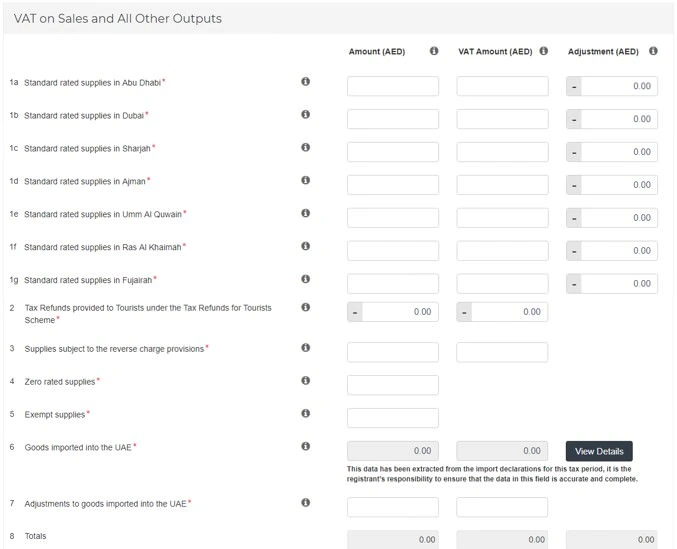
In the above section, you need to furnish the details of standard rate taxable supplies at the Emirates level, zero rate supplies, exempt supplies subject to reverse charge mechanism etc.
In each of the above lines, we would like to add some information for your read reference and ease.
Line-1a to 1g: Input the sales value (net of vat amount) in the first column emirates wise, what does it mean. Place of supply determines which emirates the number will go. The rule of thumb is, sales go to the Emirates from where the supply is made, it can be your fixed establishment office or your warehouse away from your fixed establishment.
Line-2: Tax is applicable to most of the approved retailers under Tax Refund Scheme, it will not impact any other business. More details to follow.
Line-3: In this line, you will input the products and services which are imported via the non-customs route, it means via courier companies or services rendered/purchased from abroad or online. All other imports which pass through customs will be populated automatically underline 6.
Line-4: Input supplies (sales) made at Zero Rated, in other words exports outside the UAE.
Line-5: Input supplies (sales) which are exempt from Vat, for example supplies in education or medical treatment or property sector under certain conditions.
Line-6 & 7: This line will automatically populate the imports made via customs. There is a possibility that import records as per customs do not match with books of accounts, in this case, any adjustment should be incorporated in line 7.
4. VAT on Expenses and All other Inputs
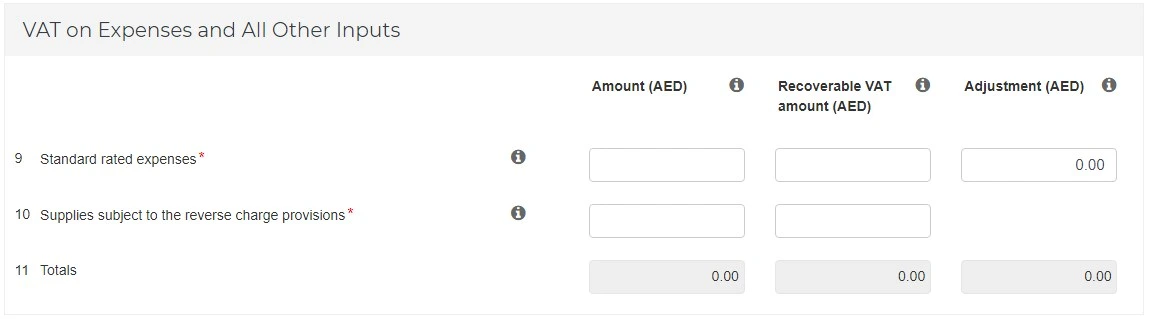
In the above section, you need to furnish the details of purchases or expenses on which you have paid VAT at a standard rate of 5% and supplies subject to reverse charge basis along with the eligible recoverable input tax. In line9, input expenses and purchases subject to a standard rate of 5%. Please remember the total of line#3 # 6 should match the amount in line 10.
5. Net VAT Due
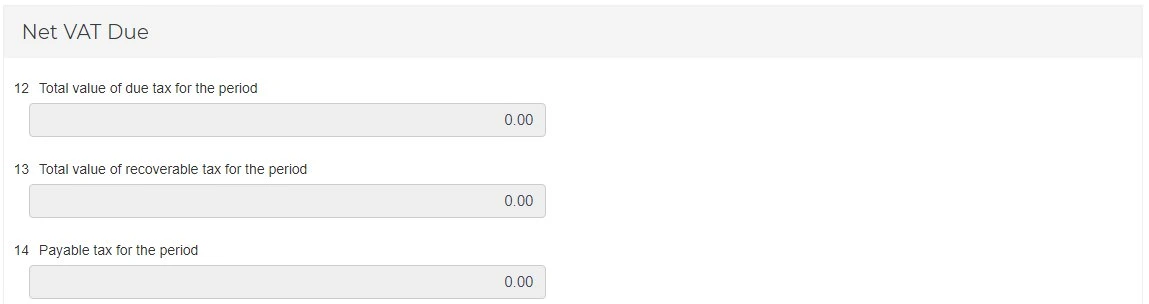
This section indicates your VAT payable for the VAT return period. The line12 reflects the total value of output which line13 shows your input recoverable tax. The amounts will be calculated based on the information declared in Sales, purchases and all other sections. The line14 indicates the tax payable to the government for the period. This will be the difference between the total tax due for the period (line12) and the total recoverable tax for the period (Line13). Either it will result in the net VAT payable or recoverable tax.
If the amounts in line12 is more than the amount in line13, the difference is the amount of the VAT that is payable by you, however, it the amount in line12 is less than the amount in line13, then you will be eligible to request a refund for the net amount of recoverable tax or carry it forward to the subsequent VAT return period.
6. Additional Reporting Requirement

This section is applicable only for businesses which are operating or using the provisions of the Profit Margin Scheme during this period, in other cases just tick No and proceed to the next section. This is just an additional reporting which does not have any financial impact on your VAT Return.
7. Declaration and Authorized Signatory
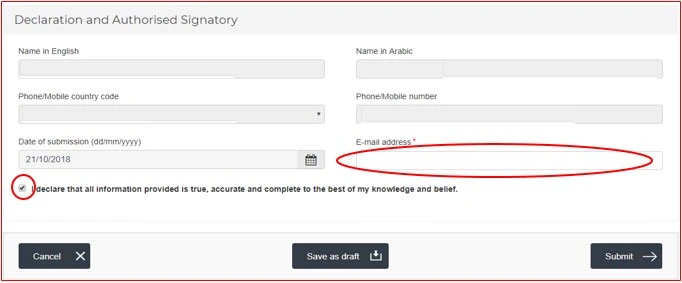
In the above section, provide the authorized signatory details and tick the box next to the declaration section to submit the VAT Return. The taxpayer also has an option to save the details as a draft and submit it later. Before submitting the VAT Return, the taxpayers have to take utmost care in verifying all the details and only when he or she is certain that all the information is correct, click the submit button. After the successful filing of the VAT Return, the taxpayer will receive an e-mail from FTA confirming the submission of the VAT return form.
8. Payment of Vat to FTA

Please note, the process does not end on clicking submit button on the portal, the actual payment of Vat amount to FTA is the second and final step to complete the Vat Return Submission and Payment Process. After submission, please navigate to the tab My Payments as shown in the above screenshot, select the appropriate button to indicate where you want to apply for that payment first.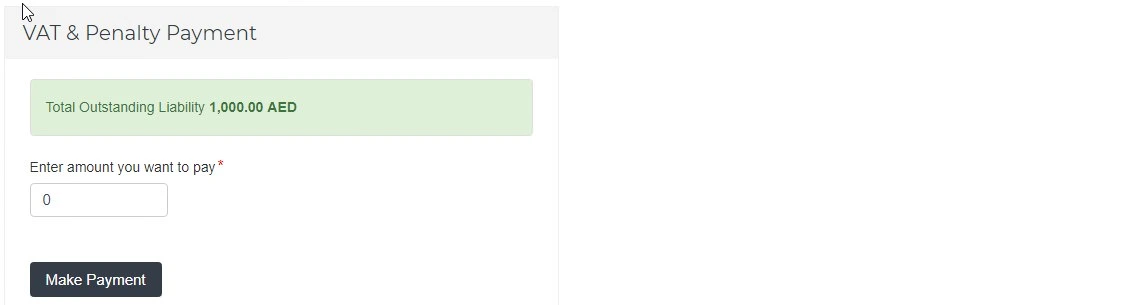
Navigate further down on the My Payments page, see the above section to make the actual payment online. Fill the amount mentioned in the green section, click Make the Payment button and choose the appropriate method and pay. Alternatively, payments can be made via exchange houses in UAE using companies’ GIBAN number.
Conclusion
The VAT Return filing in UAE requires an accurate summary of details, the detail vat working of Sales, Purchase/Expenses, output VAT and input VAT can be made separately. Make sure your details produce an accurate summary of figures to be incorporated in the required Vat Return format prescribed by FTA.
If you observe, in certain lines of the vat return, the amounts are not just consolidation of detail sales or purchases and resulting vat. In fact, it requires accurate treatment of business transactions with respect to the vat. For example, standard-rated sales are required at the Emirates level, the taxpayer is required to furnish only those expenses or purchase on which he is eligible to recover the input VAT, etc. It will be highly difficult for a business to manually collate and compile transactions for filing VAT Return. By doing so, business always carries the risk of missing output or input vat reporting or deadlines which eventually leads to non-compliance. Therefore, we highly recommend using simple accounting software and an expert; there are a lot of professional Vat Consultants in Dubai and the UAE.
Important note and Disclaimer
The guide and explanation in the above article does not form our opinion in any form whatsoever. Therefore, before using the guide and concepts explained in the article, we highlight recommend to seek expert Vat advice & consultancy from your auditors or Tax consultants.
It is important to note, after going through the above guide, it seems tax return filing is simple, however, it is not the case, right treatment of each and every business transaction with respect to Vat is the base and pre-requite for accurate tax reporting and compliance. A tax consultant can advise you on a case to case basis and as per the nature of the business. Therefore, we highly recommend seeking, if not already, support of an expert tax consultant to advise you throughout tax journey in UAE. Our next article will talk about how to choose the right Tax Consultants in Dubai and what are the pre-requisites for accurate tax reporting and vat return submission.


Leave A Comment